domains · weather
weather data at forecast speed
Operational weather is the hardest data problem in the Earth sciences: enormous volumes, arriving on a cycle, needed immediately. Earthmover stores it as analysis-ready data cubes you can query the moment a run lands.
the data
What we store
Forecast cubes
Deterministic and ensemble output from NWP and AI models, appended cycle by cycle as a single logical dataset rather than a directory of GRIB files.
Satellite
Radiances and derived products from geostationary and polar-orbiting platforms, on their native grids.
Radar
Volume scans and gridded composites, chunked for both timeseries extraction and full-domain sweeps.
Soundings and observations
Upper-air profiles, surface networks, and other point observations alongside the gridded data they validate.
on the platform
What Earthmover adds
-
Cycle-by-cycle updates — each forecast cycle is an atomic commit, so readers never see a half-written run.
-
Low-latency access — pull a single point timeseries or a whole field without downloading the archive.
-
Reproducible verification — pin a skill score to the exact forecast version it was computed against.
case studies
Teams building on weather data

Beyond Weather
Replaced NetCDF workarounds with on-demand visualizations of fine-tuned AIFS forecast models — shipped in a week.
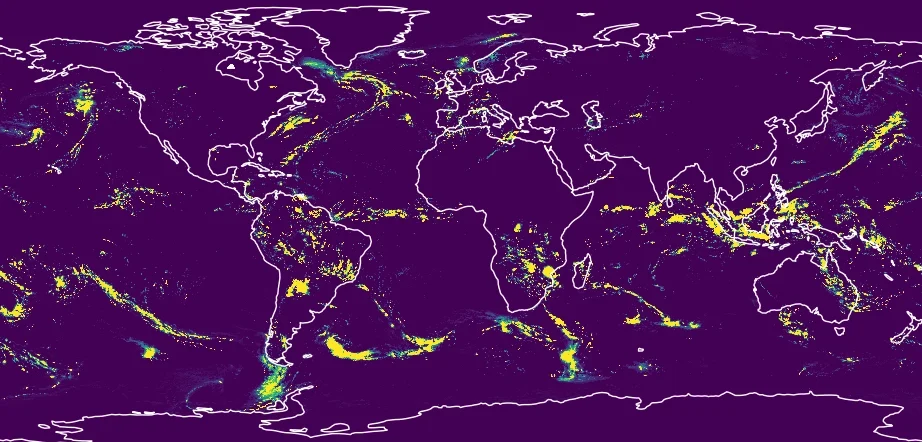
NASA GES DISC
A million GPM IMERG precipitation files presented as one analysis-ready data cube, with a 100x speedup on timeseries extraction and no data migration.