solutions · public sector
every nation's data deserves modern infrastructure
Agencies worldwide hold petabytes of weather, ocean, climate, and Earth-observation data locked in legacy formats. Earthmover makes it cloud-native, AI-ready, and governed — built on the open-source standards our team created and maintains, deployed on your cloud, with your data never leaving your control.
In production for the UK's ARIA, piloted with NASA, and adopted by NOAA's National Weather Service — while the open-source standards our team builds run at NOAA, NASA, USGS, ECMWF, the UK Met Office, and beyond.
The Access Gap
The data is invaluable. The access is stuck in the 1990s.
Governments steward some of the largest and most valuable scientific archives on Earth — tens of petabytes of weather, ocean, climate, and Earth-observation data. Most of it sits in legacy HDF5, NetCDF, and GRIB files that are slow to access and hard to govern.
-
Legacy formats at petabyte scale: agencies steward 50–70 PB across object storage with no analysis-ready, cloud-optimized layout — so every analysis starts with a download-and-reprocess step.
-
AI mandates stall on legacy data: teams are now required to make archives AI-ready, but you can't stream thousands of NetCDF or GRIB granules straight to a GPU — training and inference bottleneck on preprocessing.
-
Slow access blocks science: pulling one timeseries from a granule-based archive can mean touching thousands of files. In NASA's own benchmark, a one-month timeseries from GPM IMERG meant querying 1,488 separate granules.
-
Reproducibility isn't built in: research and operational model releases need versioned, citable data states that legacy archives simply don't provide.
-
Governance and procurement friction: agencies need RBAC, SSO, audit logging, and data-residency guarantees — and a vendor that fits national procurement vehicles instead of fighting them.
The data is already paid for. The bottleneck is access — and now AI-readiness. Both are solvable infrastructure problems, not a reason to migrate a hundred petabytes.
One platform, three mission contexts
Operational, research, and public dissemination — on one data layer
Operational
Mission-critical forecasting and monitoring at the highest reliability bar.
Research
Reproducible, version-pinned model data for science line offices.
Public dissemination
Open, analysis-ready data delivered to the public and partners at zero friction.
Capabilities
Built for the agency mission
AI-ready by default
Icechunk presents archival HDF5, NetCDF, and GRIB as analysis-ready Zarr cubes that stream straight to training and inference — version-pinned so every AI experiment is reproducible.
Modernize in place
Convert legacy HDF5, NetCDF, and GRIB to cloud-native Zarr and Icechunk — phased, dataset by dataset, with no rip-and-replace.
Reproducible by design
Icechunk versioning gives every model release an immutable, citable tag — so a research line office can track model states from one release to the next.
Your cloud, your data
Data stays in the agency's own S3, GCS, or Azure — including S3-compatible sovereign and on-prem stores. Earthmover holds only catalog metadata and the control plane, never the bytes.
Standards-based delivery
Compute serves OGC-standard APIs — EDR, Tiles, OPeNDAP — so existing tools and partners connect without custom integration.
Enterprise governance
SSO and SAML (Okta, Azure AD, ADFS), RBAC, MFA, and three-layer audit logging across infrastructure, application, and identity.
Measured, not marketed
A 100× speedup — with no data migration
Extracting a one-month precipitation timeseries from 1,488 GPM IMERG granules. Icechunk virtualizes the archive as a single analysis-ready Zarr cube directly on S3 — the same access pattern that feeds modern AI training.
Time to extract a one-month timeseries · lower is better
Why Earthmover for government
We wrote the open source your scientists already use
For more than a decade, Earthmover's team has built the foundational open-source technology that lets scientific data work in the cloud — authoring and maintaining Zarr, Icechunk, Xarray, and Pangeo. These are the standards your scientists already run, adopted across NOAA, NASA, USGS, ECMWF, and the UK Met Office. That track record makes us the strongest continuity, AI-readiness, and anti-lock-in answer a government buyer can get.
-
Continuity by design: if Earthmover ceased to exist tomorrow, your data is still in open formats, readable with a single line of Python — no proprietary engine, no migration.
-
Data residency first: your data stays in your bucket, you control the IAM, and we never store your bytes.
-
Procurement-ready: available via AWS Marketplace, as a direct award, or as a platform component subcontracted through a prime integrator — registered for U.S. federal procurement and deployable under sovereign frameworks elsewhere.
-
Compliance built for scrutiny: SOC 2 Type II certified (Insight Assurance, May 2026), with data-residency and customer-VPC deployment options for the strictest environments.
In the field
Trusted with sovereign and operational data

ARIA — Forecasting Tipping Points
A full production customer: Earthmover provides the Simulation Catalogue for the UK's ARIA programme, on the NERC JASMIN sovereign research cloud — giving 26 research teams a federated, GitHub-like catalogue across on-prem and commercial cloud.
Read more
NOAA — NWS CIRRUS
Earthmover joined Booz Allen Hamilton on NWS CIRRUS, NOAA's next-generation cloud platform replacing the decades-old AWIPS — with Icechunk as a core format for the operational data lake.
Read more
NASA — Earth science archives
Earthmover piloted Icechunk with NASA — including a published benchmark showing 100× faster Earth-science data access — with ongoing engagement through NASA's Global Modeling and Assimilation Office (GMAO).
Read more
Destination Earth
Earthmover is engaged with Destination Earth, the EU's high-precision digital twin of the planet, to help make its petabyte-scale data cloud-native and analysis-ready.
VisitBeyond direct engagements, the open-source standards our team maintains — Zarr, Icechunk, Xarray, and Pangeo — are in production at agencies and weather services worldwide, including NOAA, NASA, USGS, ECMWF, and the UK Met Office.
Resources
See the platform in mission contexts
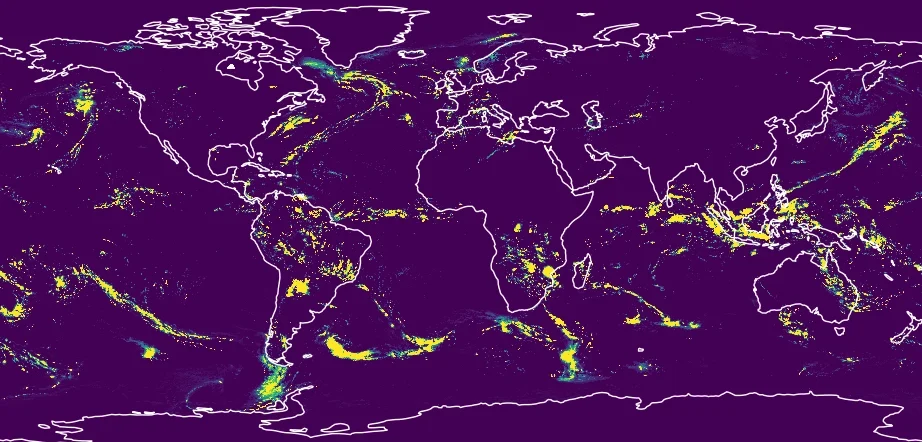
Solving NASA's Cloud Data Dilemma: How Icechunk Revolutionizes Earth Data Access
Earthmover helps NASA achieve a 100× performance boost for cloud data analytics with the Icechunk tensor storage engine — without migrating the underlying archive.
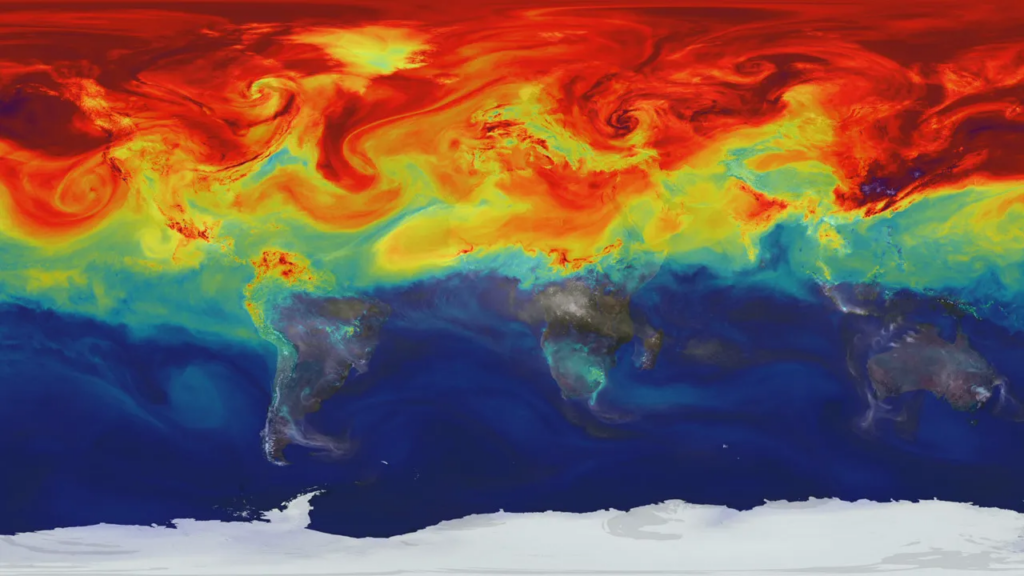
Earthmover Selected to Power ARIA's Forecasting Tipping Points Simulation Catalogue
A federated data catalogue spanning the JASMIN sovereign research cloud and commercial cloud, enabling 26 research teams to share and analyze petabyte-scale climate simulations.